–
Even if we set aside the question of whether or not a player can actually win D&D, the title of this post makes a strong statement. Today’s post is about the perils of invoking a railroad in order to tell a story you want the players to experience, and then letting the players win so that they feel triumphant.
–
The Situation
We are playing in a deadly 4e D&D Dark Sun campaign. My PC, let’s call him Conan, was down for the 3rd time and he had no surges left (and no way to activate them even if he had). This was an arena battle, so his death would not cause a TPK. Conan’s opponent was awaiting the judges’ ruling on whether to let him live or perform the coup de grace.
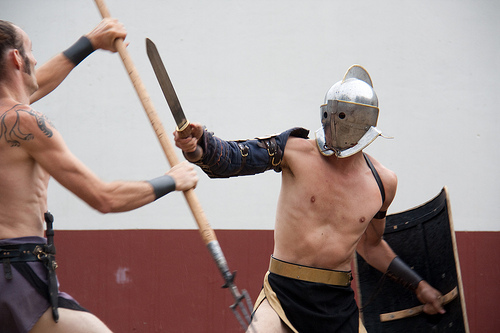
To my mind, there was no good reason for the Arena Judge to let Conan live. I felt like he would have had a courageous death and I was okay with having to roll up another PC. [Aside: One of my own personal house-rules is that resurrection doesn’t exist in my 4e games because I think it takes the gravitas out of death] The next thing I know, the DM* says that Conan unexpectedly lifts up his sword and impales his opponent – sword right through the throat – and then Conan miraculously stands up, barely alive. Apparently the DM had planned this all along so that Conan would go down only to be miraculously reborn… The problem? I didn’t feel that it was an epic cinematic scene – it felt like he was letting us win. Like he was modeling the game so that it gave us the story he wanted it to give us, rather than letting us contribute to the story.
Recurring items in a game produce a fine line. A recurring idea, event, or stylistic theme may help the players get familiar with the campaign, ultimately leading to more involved and excited players, or it may lead to repetitiveness and stale story-lines. Sometimes it is good to walk that line and venture into the stale territory – making mistakes and realizing it makes anyone a better DM.
Some Solutions
1) Try to stay near the middle of the railroad continuum. Railroading is not a yes or no activity, like a light switch with two settings; on and off. Instead, railroading runs along a continuum. The levels of railroading go from 100% determinism in the story, to giving players limited choices, to having a completely freeform campaign with players determining 100% of what the party does next. DMs run their games somewhere on this continuum and their style can fluctuate over the span of a campaign. Too much choice often gives players analysis paralysis. Too little choice may lead to players feeling like everything is determined beforehand and their action don’t matter.
2) Don’t plan every single piece of the story ahead of time. If you want to manipulate the players into doing something or going somewhere specific, motivate them by including their backgrounds in the story. Nothing motivates a PC, or gets a player more involved in the story, than making it relevant specifically to that PC.
3) Make sure you take the time to put the spotlight on each PC, giving their player a chance to make their PC important to the story and the rest of the party. Not every PC has to shine in every session, but each player should come to feel that their PC is important to the game as a whole. Avoid focusing on only one character in the story for too long because it reduces the other PCs to supporting roles. I try to run a game in which everyone gets their own spotlight time.
4) Never let them win. The PCs should earn it when they win, and the collateral bonus is that the victory will seem worth it to the players (especially if it was challenging). If the PCs die and then suddenly come back to life it is actually not fun for them because they didn’t earn it. It cheapens the accomplishment of beating the bad guys.
5) Don’t plan every awesome moment of the game – let them happen naturally. The desire for a cool story is a big one for most DMs, but DMing and adventure creation is not the same as novel writing. If you insist on planning every single story point, you may as well narrate everything to the players, including combat. Instead, let your players contribute to the story and make decisions about the world in which they adventure. This cuts down on the DM workload and also encourages player participation.
–
Overall – make sure that everyone at the table is having fun. That is the most important rule of all.
*This DM is a friend of mine. I’ve played 4e with him for a couple of years now and he is a very good DM. But he was trying a new style in his game.
–
Hopefully this article gives you some valuable tips that you can use in your game to increase the fun.
Until next time, I wish you good gaming.
~DM Samuel
–
Gladiator fight image subject to creative commons attribution, was taken off of Flickr on 10/29/2010 and is property of hans s and the Arena image subject to creative commons attribution, was taken off of Flickr on 10/29/2010 and is property of Allie_Caulfield
When I saw this post pop up on twitter, the title concerned me (“Surely the players have to win SOMETIMES” cried my worry-voice), but after reading through your article I agree with you 100% on your point here. PCs shouldn’t win for the sake of winning, where’s the adventure in that? In your specific example (and I don’t know how long this character had been played/where you guys were in a particular quest/etc), I also agree with your decision: death at that point would not only be memorable and heroic, but it would fit with the (from what I gather from your few words) story.
“We who are about to die salute you!”
And Party On!
-Ryan
I’m with RC; the title had me ready to read an article I would disagree with, but in the end I agree with you completely.
Large scale railroading is not appropriate to most groups, and especially not in a situation like the one you described.
I need help please! I’m running a campaign of a game I made with some of my friends, and one of the members never does anything without being paid enough. Right now I sent the party through a cave with a mage. The party is level 2 and the mage is the same level. He says theres no reason for him to keep the mage alive, but killing him would only help the adventure crumble. PLEASE help me out here! How can I be clever enough to stop him from killing the mage, and, in the future, take quests without getting that much money, if not none?
Remember: you run the world. You can manipulate everything to fit your design. If the player insists on killing the mage, let him. Let the world react realistically to what the players do. If the players murder an ally, then they deal with the consequences. If they murder an antagonist that you plan on using later, bring in his twin/cousin/other associate who shares everything with the dead villain except for a name, and you get the luxury of adding a vengeance motive.
If all else fails, flush the adventure. Start a new one, and mine all the good ideas from the one you had to ditch. It’ll still be new to them.
I’m on exactly the same page as you on most of this. However, point 4 leaves me a little doubtful. I agree in principle, but I have a very hard time always living up to it.
If the player has put an awful lot of work into the character’s background and I’ve planned out in my mind how a whole adventure is going to utilise that background, and then the character nearly dies in a fight in another adventure…I’ve been known to fudge it a bit, simply because it would be a bummer for the character to die at that point.
I do however agree that if the character blindly wanders into a situation where he or she is overmatched, then no amount of story concern should stop the DM from letting the dice fall where they may. I just hate to lose both my own prep and the player’s investment in a character because of a string of unlucky (for the character) rolls.
I have by the way manipulated my PCs to go somewhere specific at a specific time in my day, but mostly using things like the kidnapping of an ally or what not. I guess that’s legit background motivation and I don’t disagree on point 2 too?
@Thelodahl, I agree with you, actually. The type of “letting them win” I’m talking about is a blatant “you suddenly aren’t dead and I am invoking the hand of god to save you” sort of activity on the part of the DM, rather than the subtle dice roll change that you are talking about.
To be clear, I roll all attack and damage dice in front of my players so there is no ability to fudge for me, but I do understand when DMs don’t roll that way. I find that a completely acceptable way of handling the situation you describe.
@Kaliam, I am addressing your request for help in its own post, look for that for a few minutes :)
Cool. It seemed that we agreed, just wanted to make sure :-)
I’ve always rolled behind the screen – to preserve fudgeability and because I and my old group use to read Knights of the Dinner Table, and they were always going on about that screen so the habit kinda stuck – but recently I offered my players to begin rolling without the screen. They had no interest in that, I guess because they were used to the other thing. It’s not like they couldn’t die at all WITH the screen.
Is this something that you discussed with your players or have you simply always rolled that way?
@thelodahl, I always roll skill checks and other things behind the screen, but att and dmg rolls in front of the screen. It’s just the way I run my game… I have a dice tray that I always roll in (it’s sort of an anal habit of mine).
The players don’t seem to mind. I also feel it adds to the game when the players see that they are earning the win even though I’m rolling well, or when they see the dmg dice of the creature and know that it’s a powerful foe. Makes the game exciting.
@DM Samuel
(I’m learning proper forum ettiquette as we go…)
Thanks for sharing. I always assumed that DMs rolled in front of players to make the game be more fair, but I totally get the excitement factor and that they triumph more if you roll well and they still win. This last point will actually make me broach the subject again at my table, I think.
I do find that the players are plenty aware of the power level of the monsters from the sound of me rattling a fistful of dice, though :-)
I do my best not to take player capabilities into account when I design encounters. The idea is that I don’t want to inadvertently give them only challenges I know they can deal with. I also don’t want their characters’ limitations to handcuff me when it comes to encounter designs. For instance, I had writer’s block recently until I decided to rotate the map I planned to use and make it a vertical room. I didn’t know whether any of them had Athletics trained, and only a vague idea of special movement powers they might have. I did tweak some of the DCs for jumping, but other than that they’re having to work carefully to get around.
Having a good failure contingency helps. I never, ever care if PCs fail skill challenges because coming up with the failure contingency is the first thing I do. That frees me up to pick skills, DCs, and complexities that make sense to me, rather than what I think the PCs can do (not that they’ll do what I think anyway). For combat, this is a bit harder, since failure usually means death. Once again, I must recommend that people plot out non-TPK alternatives to combat in advance. It’s not easy, but it can solve a lot of problems.