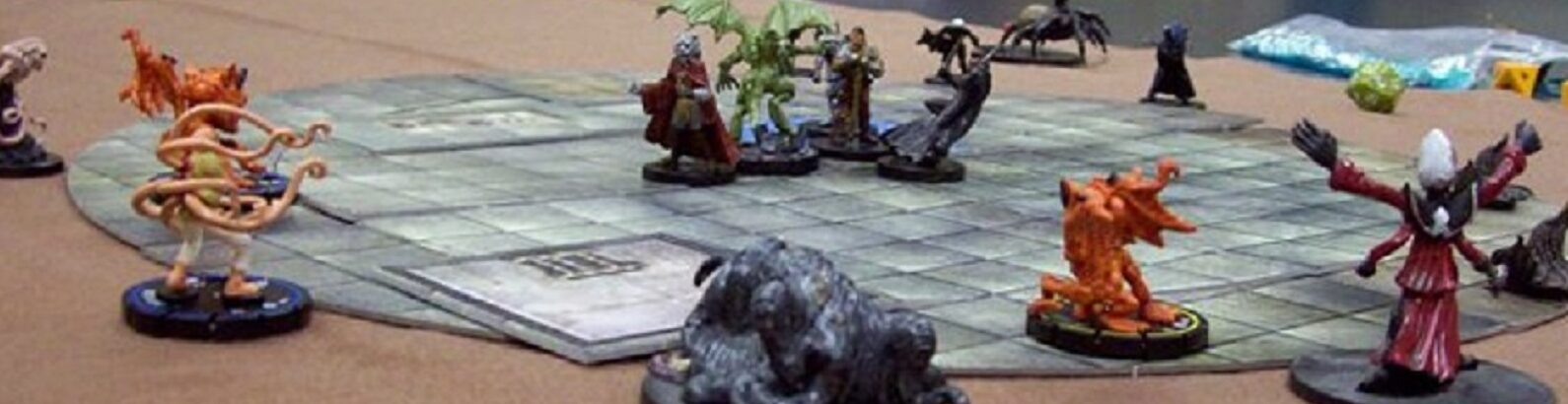
I was doing my normal weekend reading of blogs and noticed that @theweem had posted a response to the 2nd episode of the 4 Geeks 4e podcast (on which I am a host, plug, plug). In the podcast, the hosts answer the question, “Why do we play 4th edition D&D?” Weem responded to the question on his blog, theWeem, and I responded to him. My response was centered on how I run a story-driven D&D game and, well, I would like to expand on my response without taking up more space on his blog, so I decided to post it here.
–
THE FOCUS ON COMBAT
One of the early (and continuous) complaints about 4th edition D&D is the combat focus. People cite one of the reason they don’t like 4e as being the rules focus on combat and the inability to role-play to which that focus apparently must lead. Let me be clear here and say that I don’t actually believe that a combat focused rule-set leads to a role-playing-less game. I do agree that the rules are combat focused, but not that it makes the game incompatible with role-playing. The combat focus was an intentional design decision.
They designed 4e so that combat was rules heavy and you can run the role-playing in any way that you like. It’s the “we’ll give you combat rules, it’s your responsibility to put the players in situation where they MUST role-play” school of RPG design. And I like it that way – it gives me a lot of freedom to run the game the way I want to. The idea of Skill Challenges largely failed in the beginning (and still do for many groups) because it is an attempt at putting a strict rule-set on role-playing and it just doesn’t work that well in many groups. I feel, in many cases, that it puts too many constraints on how I want my players role-play a situation. [side note: I am slowly learning how to integrate skill challenges into my game, but that is really another topic so I won’t address it further in this post]
Based on my statement above, it is up to the DM to encourage the sort of play they want to see from their players. Any DM can run a combat light, role-playing heavy game in any RPG system. A DM that chooses can even get role-playing out of their players during combat. How? Well, encourage your players to use their powers in new ways… e.g. tweak the powers and then narrate the action. Encourage them to ask to use skills during combat as a minor action in conjunction with a standard action power (and then have them narrate the action). Teach them to play how you want them to play – don’t let the powers run the game, let the powers facilitate but not be overbearing.
–
STORY DRIVEN GAME
I do agree that it seems that 4e can push combat focused games on people, but ultimately it IS the DM’s choice how to run the game. I try to run story driven games. Many people say that and we may mean different things, so I will tell you what I mean by telling you a little bit about how I do it:
1) The first session of any 4e game I run is almost always a party building session. I don’t mean making PCs, that gets done beforehand and everyone can talk about what classes/races they are considering away from the table. What I mean is that we spend 2 or 3 hours cooperatively building the histories of the PCs, the party, and sometimes the world. Cooperatively means that everyone gets to have a say and everyone agrees to the final “product.” I posted about cooperatively building the party on this very blog in May (you can read that post here). Note that this is not a static activity – all of the players are involved and the DM bounces ideas and questions off of the players just as much as they do the DM.
2) I try to run a game with many choices. The party gets to decide what we do next and in what direction they take the story. That means lots of prep for me, because I have to be able to have something ready based on what they choose. I usually have 3-4 encounters set up, based on different possible directions so that I can accommodate their choices. We don’t run 3-4 encounters in a session, I just have them ready “just in case.” Typically I will run 1 (or maybe 2) combat encounters in a single 4 hour session. Most of the time is spent role-playing. There is an over-arching storyline with a main villain, but that is usually developed after the first 2 or 3 session, after the players have gotten comfortable as a party and explored the world a little bit. Usually, the main villain falls out of a smaller quest and becomes a focus because the players pick up on something and pursue it, turning it into a bigger deal that even I had planned (and that is a good thing!).
3) I let the backgrounds of the PCs heavily influence what happens in the world. I try to offer ample options for each PC to be able to explore some unfinished business in their past, whether it is earning redemption, getting revenge, winning back the respect of their tribe, finding a long lost family member, or whatever else may be applicable to the PC. These things often drive the story – after all, the story is ABOUT the PCs, not the other way around. In other words, the PCs aren’t IN a story, they ARE the story.
4) The world continues to exist when the PCs aren’t there. What I mean is, if the party visits a town in one session, they might meet a bunch of people, do a quest for someone, piss off someone, or get in trouble with the law (or any of the 1 million other things that can happen with a group of creative players). Then they leave the area and adventure elsewhere. When they go back into the original area (be it weeks, months, or years later in game time) there have been changes. There consequences for the actions they took the first time they were there. The town wasn’t frozen in time as soon as they left, the NPC inhabitants went on living (assuming the survived the first visit by the PCs, LOL). The party will see a place that is different from what they experienced the first time. This makes the world around them dynamic and exciting. The reactions of the NPCs to the players will be varied and the PCs will get to react to those reactions and once again change the game world. The direction taken is based on what the PCs want to do at that time.
5) Each combat that I run has to meet 4 strict criteria of they are cut from the game:
- a) it must be necessary in terms of the story
- b) it must be obviously meaningful to the players (though this meaning may be revealed later)
- c) if it can be avoided, there must be that option available, and if it can’t be avoided there better be a very good reason why
- d) if it can’t be completed quickly, then it better be a very important “boss fight.” Quickly, in 4e terms is no more than 45 minutes with a party of 4-5 players.
These 5 things make for a very story driven game. The story is driven by player choice right from the outset of the game. Players that really enjoy only combat usually don’t stay in my games very long – they get bored. That doesn’t mean my players don’t get to kick some ass, because a lot of the time they truly own the battlefield, it just means that it isn’t the focus of my game, even if it seems to be the focus of the rules.
–
I hope that gives you a little insight as to how I run my games, and maybe some advice on how to make your games more story driven (assuming that’s what you want). But remember, the point is to have fun, so make your game however you want as long as everyone is having fun.
–
Until next time, I wish you good gaming!
~DM Samuel

–
Top picture from Dungeon Magazine #155, Bottom picture from Dragon Magazine #372
Good post. I bristle at people complaining there are limited opportunities to RP in 4E. And I totally agree with WotC’s focus on providing rules and options for combat. You need a clearly defined ruleset for running fights. You don’t need a clearly defined ruleset for getting information from the local tavern barkeep. Somehow in that focus of explaining more about combat that RPing situations, 4E got lumped into ‘it’s all about combat’ category.
I agree. I also like to point out that there are no special rules for role-playing attached to any of the other editions either. So it’s not like 4e is the first combat focused rule-set for Dungeons and Dragons.
Not only that, but the Skill Challenge mechanic creates a decent enough framework that even weaker RP-ers can stay involved. I may end up writing a post about how to use Skill Challenges to ensure that all skill levels can feel involved.
Good article, and many points I agree strongly with. I’ve encouraged my players to look to 4e power names and flavor text to assist their RP’ing in combat. More colorful combat descriptions (“I hammer him with a Righteous Brand,” as opposed to “I hit with a 26 for 14 damage.”)
On the flip side, I’ve encouraged them to regard skill challenges as a form of “combat for RP’ing”, that is adding roll-related chances to the actions they describe, specifically to match the tension and excitement of combat.
Excellent post.
Our own 4e games are pretty much the same. We love the fact that 4e has, perhaps, the best and most enjoyable combat system of any RPG currently on the market. Unless we’re just kicking back and playing a one-shot beer-and-pretzels session where we crack open the Dungeon Delve and run three straight encounters back to back (those are fun too!) though, our game sessions tend to average just one or two combat encounters at most. Sometimes there are none at all.
The rest of the time is spent role-playing – interacting with NPCs and each other, investigating clues and immersing ourselves in the game world. The great thing is that 4e supports all that too with Skill Challenges (which I love), minor quest rewards and an utterly brilliant character generation system that allows players to create that character they want rather than a stereotypical member of a class. Want a Fighter who is an expert diplomat, a Wizard who is a master swordsman or a Dwarf brought up by elves in a forest – with character generation, feats and the background options, you can. And I’ve seen ’em all.
Anyone who says 4e is “just a boardgame” has the wrong DM, imho :)
I agree with what everyone here is saying, but I’d like to make a point which really has been bothering me. Even though 4e can have just as much roleplaying as any other edition of D&D, in a way WOTC has been marketing the game as tactical miniatures combat game. Let me explain. This new “Encounters” series, (which WOTC has been pushing at gaming stores as a way to get people into the game and a way for people without a lot of time to play), is basically devoid of roleplaying. It is just a series of combats with little or no story. Different players can jump in and out on weekly basis with different characters. There is no continuity and it has a very modular style. It is as far away from the classic campaign feel as you can get. I’m amazed that people play this style of 4e with no story, character development or role-playing. Any hater of 4e who observed a session of “Encounters” would argue that their criticisms of 4e were correct all along. To be fair, I haven’t played the DARK SUN series which started this Summer, but I doubt it would be any different. At the local gaming stores here in the Tampa area the tables are crowded for “Encounters” yet I’m having a Hell of a time trying to start a home campaign. I think many people just assume that this combat-heavy, minimal roleplay style is the way 4e should be played.
I agree with you about the marketing. In fact, I voiced this concern (i.e. that I wondered what happened to Encounter players in terms of role-playing) on the last DM Roundtable podcast. You can find that episode at http://dm-roundtable.com
@SarahDarkmagic had some good things to say in response to my concern. She said, in essence, that the combat part of the rules are the most solid and easy to understand part of the system, so if you want to take a completely NEW player and ask them to play a game for a couple of hours, it need to seem easy to learn and play. Therefore, they can use a program like Encounters to show people how the crunchy parts of the rules work with the hopes that then those people will feel more comfortable joining a game that includes role-playing elements.
I think there is some validity in thinking this might work, given the cool maps and miniatures and player character cards that are on the table during an Encounters game, and given that it is more dynamic and more likely to get people to ask about it than a pure role-playing or heavy role-playing session would. But Ultimately I’m not sure how well people are moving from Encounters into more traditional games – I have no data on this and it isn’t likely to be releases (if WotC is even trying to measure such a thing).
Thanks for the comments everyone – good discussion!
@mike
I’ve checked out some encounters and I don’t know that I’d say they are “devoid of roleplaying”. One I sat in on was what I would call “RP Lite” but the other had lots of good role play happening. I think encounters, like any 4E game is going to be based on what the DM brings to the table.
That being said, I agree that 4E rules are combat focused. Like another said here already, so is every iteration of D&D. In fact, 4E is the first edition that actually attempted to codify some RP elements, such as skill challenges. This tells me that they must thing they are important enough to include.
My one complaint with 4E is that it is designed such that it REQUIRES maps and minis. I’m an old schooler from 1E and the only maps we ever had were graph paper maps, usually hand drawn. Combat took place completely in verbal description. We’d point at the map and describe our actions in regard to our rough location, but never even really considered using minis. Now, you’re pretty much forced too. I like the tactical feel of the combat, but I don’t like that I’m forced to play to rigidly tactical. It makes combat take longer, which also leads to the impression that it’s very combat heavy.
I agree that the assumed use of minis does lend to the perceived high combat focus. On the other hand, it’s not as though minis didn’t exist until 4e. Way back in the early 80s, my brother and I were buying Grenadier and Ral Partha lead figures to use with our AD&D setup. 3rd edition also recommended the use of minis to make combat easier to resolve.
I get your point though, back in the 80s minatures were used as enhancements, nowadays it seems they are needed to play the game. 4e does assume the use of minis, but I know for a fact that you can play the game without minis and battlemats. You can play in the old school way, but it takes some getting used to and some patience. Also, all the players at the table have to be comfortable with envisioning a more abstract use of the “square system” as described in combat, as well as comfort with a much higher level of DM fiat during combat when there are no minis in play. DM fiat was relied upon much more to resolve conflict in every other edition – 4e took that away in a large percentage of the game, the trade-off is, in part, the use of minis to determine the outcome of battle.
Good article, good tips, and thank you for that! My two cents on 4e is first and foremost that it ROCKs and I dearly love it. My own gaming group really looks forward to our weekly Monday night game! That said however … if our DM announced to us that he wanted to use 4e for a deep RP story driven game … I’d likely bow out and find another 4e group who wanted a straight 4e game. Why? We have a good group, he is a damn good DM. Because 4e isn’t optimized for deep RP story driven stuff and because the rules don’t really facilitate that kind of game very well … in my experience … it gets rather frustrating trying to make that work. In reality if you have the right kind of DM and group … you don’t even need rules … you can sit around the table and weave an interactive story if you want … I suppose you can try to do that with 4e … to me though the huge question is … WHY?? There are dozens and dozens of other systems out there that facilitate that to a much greater degree … GO PLAY THOSE GAMES if deep immersive story driven amazing RP is what you want.
I hate it when people try to shoe horn something into games that really can’t accommodate that very well. If you want a story driven game … why the hell don’t you use Burning Wheel or any of the awesome old school clones (Labrynth Lord, OSRIC, Swords and Wizardry, etc. etc. etc.). Why do people feel compelled to mod up stuff and force things … ending up with a bastardized experience that is half as fun as it could have been. 3.5 and Pathfinder ALSO SUCK SUCK SUCK badly at providing an immersive, deep RP … story driven experience. As soon as D&D shifted to grid based mini-centric complex combat … story would forever be a distant second. You can have a cool storyline … you can have interesting RP vignettes … BUT … at the end of the day if your group has 5 or 6 hours once a week … and your playing the combats by the rules … your going to have about at best … 2 or maybe 3 hours if you do no socializing … for non-combat actions. With that little time … its going to be one hell of a struggle to pull of deep intriguing roleplay. Yes it can be done … my old group back in Las Vegas does it weekly. They do it because they have only one day a week for gaming … they all are 40K fans who love mini games (so they love the mini centric tactics of 4e) and they just don’t have another opportunity to do any type of RPG … so they make the bastardization work. I have 3 nights a week to game … so I absolutely refuse to waste my time using 4e for something it really isn’t very good at.
I’ve played in three horrible … fail … attempts at using 4e for a story driven deep RP style game and they SUCKED … badly. 4e in general has awesome … amazing … gritty … crunchy … combats. That is what it shines at doing … that is what it was designed to do. So my preference is to use the game for what it shines at doing. Providing awesome hack and slash with some light RP on the side. For me personally I will stick with that from 4e. To each there own though … if you want to make 4e play differently … cool … whatever floats your boat I guess …
I really liked the comment that someone made regarding the blog post. It wasn’t a response to the post but a sideline comment about skill challenges:
“Not only that, but the Skill Challenge mechanic creates a decent enough framework that even weaker RP-ers can stay involved. I may end up writing a post about how to use Skill Challenges to ensure that all skill levels can feel involved.”
…
To me I think the big thing that all of the RPG theorists out there are missing is the simple equation that every game is bound by … TIME …
Yes you can have amazing RP with 4e quite easily … you could even use the skill rules from say 2nd ed combined with the combat of 4e … but at the end of the day … if you play in an average group. You are constrained by TIME … how much time do you have to get what it is done that needs to be done? Years ago I played in a weekly game where we met at noon every Saturday and went till 3 AM. We had alot of time … we were doing 2nd ed … we had alot of RP and did alot of combat. These days those kinds of games are rarer and rarer … even hardcore gamers without busy schedules struggle to put together a five or six hour weekly session. So with a game like 4e … that has somewhat complex mini centric combats that take an hour or two on average to resolve … unless you have a good 8 or 10 hour block on a weekly basis … trying to add deep long RP into the game … well your not going to be able to get much done. So then you end up with a DM fudging exp so players level up reasonably fast, etc. etc. and you have all these wonkey add on house rules etc. etc. … as I said … I’ll pass on that. 4e shines at providing cool gritty combat and it just flat out does NOT shine at facilitating really good RP. Yes of course you the DM and you the party can add that in … but the RULES do not facilitate that. Whoever said previous versions didnt do that … yes they did … there were complex skill system sets that had rules for huge amounts of non-combat activity and that added to the options that players had for RP. If your chr was a rogue with alot of aprasial abilities, forgery, etc. etc. you could use that to springboard into RP stuff. All that is removed from 4e and you have a bare bones skill set that is ultra generic and ultra universal … PERIOD. So 4e DOES NOT facilitate the RP like older versions of D&D did AND as 3.0 and 3.5 did … 4e kills the RP mood frequently with the abrupt jump to the grid … that really pulls people out of the abstract RP side of things and plunges you into tactical mini skirmish land … where things function alot more like a minis game/board game than an abstract deep RP style game.
So for me as long as I’m gaming with people who have time constraints … I’m always going to pick one or the other … deep RP … or crunchy combats … the folks I game with just don’t have the time necessary to really do awesome RP combined with awesome crunchy grid combat … justice.
@Lord of Excess: This is a response to your first comment… LOL – thanks for your response! I also love 4e and I play it as often as I can. I don’t actually change the rules though – and my story driven game doesn’t violate any of the 4e combat rules. In fact, they integrate pretty well.
The reason I use 4e instead of some other system built specifically for story-telling is that I like 4e. I like the system and I like being able to run a kick-ass tactical combat in the middle of my story-driven campaign if I want.
I think one of the things that makes 4e great is its ability to accommodate your preferences AND mine – maybe not at the same game table, but still – it makes us both happy and we have very different expectation about the game we are playing.
And I do agree with you and I say, to all of those that don’t like 4e because of it’s combat centric rule-set: Play how you want to play and have fun – if that fun doesn’t include 4e, then don’t try to shoehorn it into being something it is not.
Cheers!
Fair statement, but what does that have to do with the quote (that was mine, btw)?
@Lord of Excess: Here is a response to your second comment:
Bull!! I disagree!
Reducing the amount of skills makes it EASIER to role-play because you are forced to describe/narrate/talk about what it means that you are trained in that skill and how it applies to a particular situation.
And as far as 3.0/3.5 having skills and many rules surrounding their use… That means it has rules for role-playing? I disagree. The fact that you have a rule on how to use a very particular skill and what that skill allows you to do, and what you have to roll to succeed at it DOES NOT set up a system of great role-playing. It sets up a system where each PC has to be made and choose skills that are relatively narrow in scope (compared to 4e, anyway) and then you get to roll a skill check based on your levels or ranks in that particular skill if you are in the right situation in which to use that skill.
Other than the sheer number of skills, how is that any different than 4e?
4e also has skills and rules on what the skills allow you to do and what sort of knowledge they allow the PC to have. There is a skill training system and even skill based feats/powers. How is this different and how does it NOT encourage role-playing as much as 3.0/3.5 did?
I’ll agree with DM Samuel on this one. In my experience, 4E is more accommodating of deep RP than 3.5 ever was. Although, I too struggle with the mini based combat sometimes. To me, 4E would be the perfect balance of combat and RP, if the Mini based combat was somehow optional. In my mind I envision a version of 4E where you run combat without minis for normal fights, skirmishes, random encounters, etc and then bust out the minis and the grid for the big setpiece and boss battles. Oh, to dream.
Also, I agree, fewer skills is better for promoting RP at my table.
I’m an old schooler and have no problem with simply using your ability scores and class/race to define what you can or can’t do. Want to smash a door? Strength check. Are you able to give me a really cool story about HOW you plan to smash the door? +2. Want to make an impressive leap? Dex check. Are you able to explain what cool thing you’ll do after you make the jump? +2. Bargain with the Duke? Charisma check. Are you able to RP the conversation with me in a smooth manner? +2. Sure, thats probably a bit too vague and leaves a lot up to the DM (not a bad thing imho), but I think the 4E skillset is a nice middle ground between being too vague and too specific. The only people who I can imagine would complain about it are people who are used to having/using skills that are no longer present. No one else would ever likely care/notice.
I’m sorry, but as a DM who has run games for something closing in on two decades, I have some quibbles with your post on 4e.
First; the argument that 4e focuses excessively on combat rules is completely valid. The most overwhelming strength of D&D used to be the ease of use and simplicity of the game system. The game system quickly became transparent to both the players and DM, so that the focus of energy became the story that was being told. 4e erodes this with an excess of complexity, covering things that do not need to be covered. A perfect example of the limitations of combat-rule heavy roleplaying are found in your own post. You refer to “running a combat” like some kind of special event, and also “boss fights” as if this was some kind of video game. Combat, evading combat, talking your way out of a situation, creatively bypassing the entire DM-designed ambush thereby negating hours of DM homework, or just bashing right through it should all be equally possible and valid options, depending on what your players want to do. Because of the simplicity and ease of use of the old system, I never worried too much about prep for “running a combat”. If the players decided to fight something I had not anticipated they would fight, I could generate stats very quickly on the fly and, because of the bare-bones nature of old D&D, much of the action was always in the form of descriptive storytelling anyway.
I am amazed that you think it is somehow special or unusual to have roleplaying taking place during combat. This is a peculiar result of modern video game culture, where game designers make graphics and game mechanics, then bring in a writer at the last minute to create what they call “fluff” as an excuse to set up their “ultra cool mega boss fight”. In my games, we ALWAYS had roleplaying going on during combat. I would decide to throw in special bonuses for creative action, like swinging on a chandelier, or using a spell or power in a creative or unusual way. I always tried to place the PCs into a situation where the solution to a problem was not always obvious, and where they would hopefully have to stretch themselves to win. The idea that a PC would stop being a living, dynamic, colorful ‘person’, and suddenly become a robotic, computer like, “DPS” machine hitched to the rules like a train on a rail, and then revert after combat is ridiculous. Some of our best RP moments came in the midst of combat. I tried to set up plots so that various storylines would come together during the climax, and this often meant heavy character interaction during combat. In fact, for many of my best bosses, I ran the “boss fight” not like a video game, but like a movie, where the antagonist is character driven and I could and would bend the rules in order to achieve the goals of the plot and storyline (yes, I have miraculously saved a beloved evil nemesis once or twice, and the players actually thanked me for it, since an early demise would have been a real letdown story wise).
Your approach to building a story is your own DM business, but I can’t help commenting. Sometimes, it is good NOT to do all the set up by consensus. Your “party building session” sounds extremely boring to me, to be perfectly honest. Some of my very best campaigns ever began with my having developed a detailed plot and world beforehand and literally dropping the characters in blind, often as “aliens” in some way; people who do not necessarily know this setting and have to discover it as they go. Players love to go on a journey; take a ride, exploit the wonderful escapist potential of the RPG genre of storytelling. Let’s just be honest here, not everyone is capable of being a good DM. Some people really don’t have the imagination for it. If I start out a campaign as a consensus-driven mutual-setting building exercise, I will be either limited by the imagination of the lowest common denominator (who would be perfectly happy to be blown away by what more creative minds might throw at them), or our lowest common denominator will feel left out, which isn’t really fun. Consensus in world and setting weakens one of the biggest hooks that drive the D&D campaign; MYSTERY.
PCs are curious beasts; they love a good mystery. They want to explore and discover, and they have a hard time leaving a door unopened or a box closed (even when it really shouldn’t be opened). This is the power of the setting; that we do not NEED to mutually build it. D&D consciously built upon the most basic, common, established tropes of fantasy, which meant that the location was pretty easily comprehensible to players. Medieval societies are easily understandable, and classic fantasy mythic elements are both universally appealing and understood as a common language of imagination. This, and the VERY simple rules of the old 1st and 2nd edition, meant that the entire focus was not on “running a combat” or “building a unique world”, but on TELLING A STORY. The DM had a truly vast and wonderful array of tools available to make an endless variety of stories, based on easily understood building blocks. Tell me; is Die Hard a bad movie because a huge office building is so generic and normal to us? NO! It is the ‘normalness’ of the setting that lets us focus on the important parts; the epic story and character development. Now, in D&D you have to balance this with the mystery element, and each world becomes very unique, and a good DM likes to throw things in that the players do not expect, when they think they have everything down pat, but the basic elements are all about the story, not the rules, and not the “uniqueness” of the setting. Baowulf or Gilgamesh or Odysseus could be easily converted into ANY D&D world, and the point of these myths still comes across. We are entertained by, informed by, learn things about human nature from, and identify with mythic stories like this DESPITE rules mechanics and bizarre steampunk elements, not because of them.
I just think that bottom line, a good D&D campaign is like the modern version of a Viking Skald sitting around the campfire and re-telling new versions of the classical myths, with creative twists. We, DMs, are the modern storytellers. We show our players things about themselves that they didn’t see before through the mythical interaction of their paper avatars. They see the best and the worst in human nature as they unravel a story, discover the answer to a mystery, and basically go for an immersive, escapist, ride. This is better than movies or video games because it is a myth, a world, and a ride created custom, just for them, by someone who knows them (usually), and will alter pacing, tone, plot elements, and style based on their real-time reactions. DMing is like telling ghost stories as a kid. Focusing on what is on page 371, part d, subsection 10, is like some annoying kid jumping into the ghost story to point out niggling details that NOBODY cares about.
In conclusion;
Give Me Old School or Give Me Death!
On your first point, yes, 4e focuses on combat quite a bit and the nature of the way combat is set up in 4e makes it so that you have to pull out a combat map and set up miniatures and such. That is why I refer to it as “running combat” – that is the way the game is set up. However, my point was that it is still possible, and very easy, to roleplay at the same time as having a combat in 4e, even though combat is based on miniatures.
This also addresses your second point – NO, I don’t think it is special to have roleplaying during combat. However, a lot of 4e haters have the impression that 4e doesn’t allow it, so I was disabusing them of that notion. That was my point, not that 4e was special because of it, but because it ISN’T special because of it, it is simply in line with every other edition of D&D.
I don’t run my 4e game like a session of World of Warcraft where everyone is worried about DPS. For the record I have never player WoW (or everquest or any online MMORPG) and I don’t run my game that way. If your impression is that my game is run that way just because it is 4e, you are way off base, and that was the point of the whole article – 4e doesn’t have to be a simulation of WoW where everyone only cares about DPS.
I think you totally missed the boat about cooperative party building. From what you have written it is obvious to me that you either didn’t read my article about cooperative party building or you didn’t understand my point. It is cooperative PARTY building, not 100% cooperative world building where the players build the world and anything goes and everyone’s ideas are 100% perfect and used 100% of the time. That is NOT what I do. What I do is run a session where the party meets each other and we all discuss their relationships and backgrounds, roleplaying out some scenes and just discussion others. This builds party connections and backstory before the first session of the campaign so that I don’t have to rely on the tired old “you meet in a tavern” – instead, they have relationships in play already and they can use those when the campaign starts. Several of the players with whom I have used this technique have expressed to me how wonderful it was for them because either 1) they didn’t feel they were creative enough to create a compelling backstory for their PC and this exercise gave them the opportunity to do so in a “safe” environment or 2) they loved the fact that the group had a history and goal before the start of the campaign because it helped them find motivations and reasons for their PC.
4e doesn’t preclude anyone from telling a story. The story that is told at my game table is driven by the PC’s actions. I have a plot set up and there is plenty of mystery and lots of things to discover about the world. I run my campaign in my homebrew world so that the amount of mystery in the world is intact – i.e. they don’t get a 200 page setting book to read an memorize so that they feel like they know all about the world, and a good portion of it is not something their PC would even know realistically (this is the thing I hate about Forgotten Realms, for example). In other words, my campaign is run with plenty of mystery intact – just because I run a 4e game doesn’t mean that the players don’t experience any mystery or intrigue.
I don’t care about “what is on page 371, part d, subsection 10” and most of the people I play with don’t give a crap about that either. Stop assuming that just because someone plays 4e or likes 4e that they do this. People who play RPGs have differing preferences and as much variety as what you would find in any hobby group.
Furthermore, your post comes off as a little condescending. I have the ability to find good things in every edition of D&D. Some editions do some things better than others. Everyone is allowed to have their own preferences.
I am not an edition warrior. 4e isn’t even my favorite edition (I am a huge basic D&D fan, if you must know) but I often find myself in the unenviable position of defending 4e as a valid edition of D&D that can be played with lots of roleplaying and all of the other things you mention that make a good game.
And for the record, I am also a D&D player from way back. I started in 1982 and have played every edition of D&D and a ton of other RPGs. Your assertions seem colored by your love of old school games. You have a skewed idea of how a 4e game runs at my table and I think that is informed more by your pre-disposed opinions of 4e as a non-old school game than of what my article/post actually says.
Having said that, I urge you to go back and read what I have written, but imagine it is being written by an old-school game lover who is giving advice to new D&D players about how to make their game less miniatures combat and more role-playing. You might find that you actually agree with much of what I say.
In conclusion,
long live ROLE-PLAYING, old school or not!
I just finished a lengthy 4e campaign with my gaming group and it was a fun time. Unfortunately, we did succumb to “I’ll hit this guy with 1d8 + 5 vs. will” and it detracted from the experience.
Much of your experience depends on the DM. If s/he wants to run a story-driven, RP-heavy campaign (and the players want that), it’s entirely possible with 4e.
During your game prep time, think about your campaign’s story arc. How can you supplement that with NPC encounters? Weave in bits of your PC’s backstories to make the campaign more personal and meaningful to those characters. Drop artifacts or references to past and future events here and there. That makes the whole thing more cohesive, alive and exciting. Have a story event every now and then. Encourage use of flavor text during combat. With a little effort, you can add great story and RP to your 4e adventures.
That’s one of the reasons I love 4e so much: you get lots of opportunity to let a great story evolve PLUS a fantastic combat system.
Hello, sorry if I make some grammar mistakes, but I’m not an English native speaker.
I have read most of the discussion, and I want to make a point. First of all, we had to take apart from personal experience only, and judge a game by his most common denominator.
I see that many of the arguments are heavily biased by the “Like” factor. To put it clearly, I may like a greasy and burned burguer and say that, for me, it’s the finest cuisine. But it’s not. There is no real cooking skill put on that. And for the opposing point, yes, a great chef can make magic with three common ingredients, but how better will be his dish if he can choose between several ingredients.
To put it clearly, a great DM can make a memorable combat based on Scissor, Paper, Rock (Lizard, Spock) system the same way that a good 4ed DM can make a memorable adventure using the very, very combat focused rules.
Myself, I have made memorable (and fair) combats with the often contradictory or “unbalanced” rules of AD&D 2ed, provided that the players do more than “hack&Slash” maneuvers and combats. But I also made horrifyingly difficult (near the point of TPK) combats for new or not too great players using Goblins and such. And I’m sure that, well applied, my old AD&D players could splat the hell out of any “party oriented” characters, and take leaders, controllers, defenders and strikers up her ass with the old combat savvy and commando tactics. This is not the point.
For that said, any good DM can make an awesome adventure on any system, but this is not a valid point for defending the system itself. That would be talking about value of the DM, not the game.
As for 4ed: I’m not a hater, but I don’t like it, and I have many reasons to do not like it. If 3.5 was a hell to intuitive, “roleplayed” combats, and make a simple tavern fight an event of 45 minutes, 4ed take that up to eleven. Too much pressure on combat-oriented session (although I actually LIKE a good combat), and the near-invulnerability or superheroic (not “epic”, a commonly misused word) feeling that gives. Look at the art of the books, and you see why I say superheroic. Even 1st level characters can take an entire army whit relative ease, only by staying their ground and taking damage. Hell, they only had to rest 5 minutes to recover many of his injuries. I could easily think several ways to made that… in combat: cross a door, jab it for five minutes (one character with a bit of strenght could easily just push it while his companions recover, and then take turns). Voilà. ¿Epic? I don’t think so. Yes, you can house rule to make stressful situation don’t count as a Short Rest… but it’s a house rule, and the short time span “philosophy” of never stopping the action is betrayed. Not to mentiont that [[http://tvtropes.org/pmwiki/pmwiki.php/Main/RulesLawyer Rules Lawyers]] would complain, and with a joust cause.
I think this is called powergaming, nothing more. There is a difference between this and epic.
That aside, the main focus also alters the way that the players percieve the game. It’s not casual that many, many players percieve 4ed as a wargame or a videogame: It’s not bad publicity, as many complain; nor entirely a prejudice or “feeling”. It’s a perception, a common imaginary encouraged by the books. Yes, you can roleplay, but you don’t have to to “win” the game (the ultimately goal of any powergamer) making the most powerful (misused “epic” again) character, without even consider the effects of his actions. Hack&Slash, upgraded to deific proportions. Yet, of course, good players would never do that, but good players aren’t encouraged by the rules. Only powergamers (same as D&D 3.5) are really encouraged. Look at the time that tooks creating a character. Look at the amount of time spended in the powers selection or MixMaxing the effects. I’m not against that entirely, but yes against making this the core experience of a role playing game.
As for the miniatures: I’m not against them per se, again. I did not see a real reason other than taste to comply of the possible use of them. They add a third dimensional perspective in combat. I even used them a lot in my AD&D sessions; but then again, the obligatoriety of them bugs me a lot. There are encounters that had to be random, and preparing a map for every possible event, for every possible dungeon and take away the description dimension as the main space is too much time and effort. And always it could be in vain: what if the players don’t want to crawl in a dungeon? What if they want to attract the enemies to the outside, ambush them and then loot? What if the DM doesn’t want to expend 20 minutes creating the landscape “al pedo” (to the fart) like we say in Argentina? I enjoy making maps, but overail detail it’s extenuating. And very long range encounters, lets say a group of cavalry archers against the players, for example (my former players excel in this type of tactics)? It’s a pain in the ass with a map: it has to be huge to make it proportional to the figurines, or you got to make it doubles, change escales for changing ranges, etc. All is time spended in the preparation or even in the middle of the adventure. This leads to overworked adventures with continual stops, or too little options in play, not a sane medium point.
And for adventure outside combat, there is some rules? Yes, very few, and not oriented to the player to choose them. 3.5 doesn’t encourage that kind of tactics too, because “they aren’t as epic” as Defender and a Striker (like it’s said in 4ed). This is like to say that the Mongols weren’t epic. Or a real knight, a mounted cavalry fighter.
I’m eager to recognize the good points of 4ed. I really like the rituals (I house ruled them in AD&D way far back), the “balance” of the classes, or the combat options, as world-savvy unbalanced they are. But all this leads not to epic, but inverosimile worlds. Epic, in literature, requires verosimilitude (NOT realism). What’s the point to build entire armies if a group of four people could take them with ease? What’s the point for a king, or any other type of mundane activity, when there are so many people and monsters capable of take a god down, or blackmail them to fulfill their wishes?
It’s not the same as say that one person can recover really fast from his wounds. This MUST be the rule for monsters too, although a little sympaty could be used. Balance, you see, is not only for the “player characters” but to the world too. The power escalade is far too exponential to be fair or verosimile. And yet, the “powers” as unbalanced as they are, are too little flexible if the masters don’t actively put a lot of work or asume that they can be more flexible (that usually don’t, in my experience).
This take exceptional DMs to made a good adventure. A base, common DM could not make a good roleplaying game, only a very long, a little boring and very combat-focused (not exploring nor diplomatic) game. And the base players won’t expend time and effort in making other than meatgrinder characters. A low interpretative player or thoughtful could make an equally (or even better one) combat effective character than a more thoughtful, interpretative or creative player. The only stop? An exceptional, old school master. If they don’t have the possibility to find one, the only result is a mediocre player.
This could be avoided with ease by not focusing the rules only in combat. Focus in other things, like roleplaying, exploring and social challenges, with skills that reflect them. Allow a few, simple and intuitive rules for combat, not entire trees and made mandatory the imagination in it… in the core rules.
This are the objective reasons why I don’t personally like the game. Because it requires the ideal players to make a good play, and if they aren’t, the game will be mediocre, dull and take a lot of time, appealing to the lowest common denominator: powergamers, and nothing more. I like the opposite: when the powergamers are encouraged to roleplaying, not when the roleplayers are encouraged to powergame in order to be useful.